





Advertisement
|
Top Radio News
iHeartMedia Names Lainie Fertick Chief Insights Officer
| RADIO ONLINE | Friday, October 9, 2026 | 4:24pm CT |


|
 |
iHeartMedia has promoted Lainie Fertick to the newly created position of Chief Insights Officer, placing her in charge of insights initiatives across the company and adding her to its Strategic Communications (StratCom) leadership team. The appointment was announced in an internal memo from iHeartMedia Chairman and CEO Bob Pittman and President and COO Rich Bressler.
Fertick has played a significant role in developing iHeartMedia's consumer research capabilities through Critical Mass Media (CMM), the company's in-house research organization. She joined CMM as an intern in 2004 and advanced through the organization to become President and General Manager.
In 2024, Fertick was also named President of iHeartMedia Insights, expanding her responsibilities to include research supporting the company's advertising and marketing partners.
Her work has included overseeing several of iHeartMedia's annual consumer research studies, including "The New American Consumer," developed with author Malcolm Gladwell; "The Ignored Consumer"; and "The Human Consumer," which explored consumer attitudes toward technology and artificial intelligence and helped establish the company's Guaranteed Human positioning.
More recently, Fertick led research for "Unlocking the Community-Driven Gen Z Listener," examining how younger audiences engage with audio and community-driven content.
She has also been involved with AudioGraph, iHeartMedia's data and programmatic advertising platform launched in partnership with Triton Digital in June.
In their memo, Pittman and Bressler credited Fertick with helping the company's programming operations develop a deeper understanding of listeners and their behavior.
"Lainie was our Programming team's 'secret weapon' - building our leadership position in the industry by helping our programmers, talent and stations gain deeper insights and understanding of their consumers than any other radio or media company could," the executives wrote.
As Chief Insights Officer, Fertick will oversee insights work across iHeartMedia, bringing together research and consumer intelligence efforts that support programming, advertising and the company's broader business operations.
Radio Hall of Fame Inducts Eight in Class of 2026
| RADIO ONLINE | Friday, October 9, 2026 | 11:04am CT |
|
 |
The Radio Hall of Fame welcomed eight new members during its 2026 induction ceremony and dinner Thursday, October 8, at the Fairmont Chicago, Millennium Park, recognizing broadcasters and industry executives whose careers have made significant contributions to radio.
The Class of 2026 includes Boomer Esiason of WFAN-AM/FM in New York; Dennis Green, COO of Sun & Fun Media/Key Networks; Shotgun Tom Kelly of SiriusXM's 60s Gold; Helen Little of WLTW-FM in New York; iHeartMedia Chairman and CEO Bob Pittman; Rickey Smiley of Urban One/Reach Media; and veteran radio personalities Charlie Van Dyke and Fred Winston.
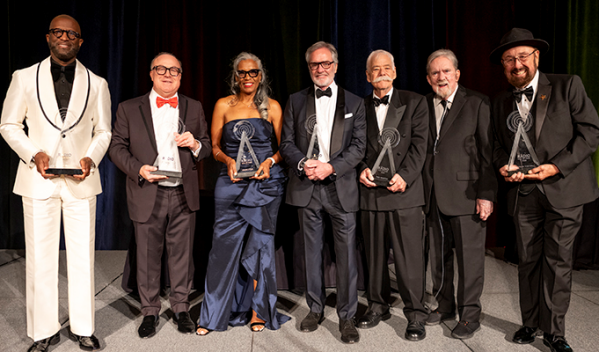
The ceremony was hosted by nationally syndicated radio personality Bobby Bones, who was inducted into the Radio Hall of Fame in 2017.
Radio Hall of Fame Co-Chairmen Kraig Kitchin and Dennis Green, himself a member of the 2026 induction class, welcomed attendees and delivered opening remarks.
Paul Harvey Aurandt Jr., son of legendary radio broadcaster Paul Harvey, also participated in the evening, presenting a special introductory tribute honoring the inductees, the Radio Hall of Fame and the Museum of Broadcast Communications.
The annual induction ceremony celebrates the achievements of radio personalities, programmers and executives whose work has helped shape the broadcasting industry.
Photo credit: Sophie Castro.
Veteran Broadcast Engineer John Bisset Dies at 73
| RADIO ONLINE | Friday, October 9, 2026 | 2:21pm CT |
|
 |
John Bisset, a longtime broadcast engineer, industry educator and author of Radio World's popular "Workbench" column, has died following a period of illness. He was 73, according to Radio World, which reported his passing October 8.
Bisset spent 55 years in broadcasting, building a career that included engineering, consulting, equipment sales and technical education. He was widely recognized for sharing practical engineering knowledge and helping generations of broadcasters maintain and improve their facilities.
His greatest contribution to the industry may have been "Workbench," the Radio World column he authored for nearly 36 years. First introduced in August 1990, Bisset began writing the feature that November and went on to produce approximately 920 installments.
The column became a favorite among broadcast engineers for its practical troubleshooting advice, equipment maintenance tips and innovative solutions contributed by readers. Its technical content also qualified for Society of Broadcast Engineers (SBE) certification credit.
Throughout his career, Bisset worked with numerous broadcast equipment manufacturers, including Harris, Dielectric, Broadcast Electronics, Nautel, Tieline, Elenos and Telos Alliance. At Harris Broadcast, he earned three sales awards and established a company record by selling 55 transmitters in a single year.
Bisset began his broadcasting career at age 16 as a summer relief announcer at WFAX-AM in northern Virginia. He eventually became the station's chief engineer and later worked in engineering management for Metroplex Communications in the Washington, DC, market.
In 1990, he co-founded Multiphase, a broadcast engineering services company. He also served as regional RF sales manager for Broadcast Electronics and helped develop several products at Dielectric, including the Dielectric Pattern Viewer.
Education remained a central part of his career. Bisset presented and moderated Radio Transmitter Workshops at NAB conventions and frequently participated in SBE Ennes Workshops and local chapter meetings. In 2007, the SBE honored him with its Educator of the Year Award.
Beyond his technical expertise, Bisset was known for encouraging cooperation between engineering departments and station management. He frequently emphasized the importance of documenting technical work, communicating the value of engineering investments and maintaining safe working conditions.
"It is really important to let the people above you, the managers, the owners, know that you are taking care of their facility and are doing a good job with it," Bisset once said during an appearance on "This Week in Radio Tech."
Radio World Editor in Chief Paul McLane said "Workbench" will continue, as Bisset had wished, with a new author to be announced.
Bisset had continued writing the column until taking a hiatus this summer to address health concerns. He is survived by his wife, Diane.
Source: Radio World, reporting by Nick Langan.
Advertisement
|
Benztown Produces Tribute to NFL Legend Mike Ditka
| RADIO ONLINE | Friday, October 9, 2026 | 2:08pm CT |
|
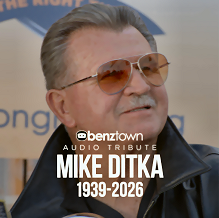 |
Benztown has produced an audio tribute honoring legendary NFL player and coach Mike Ditka, who died Friday, October 9, at age 86. The tribute was voiced by Darren Silva and written and produced by Thomas Green.
Ditka, one of professional football's most recognizable personalities, was best known for leading the Chicago Bears to victory in Super Bowl XX following the 1985 season. His fiery coaching style, trademark mustache and relentless competitive spirit earned him the nicknames "Iron Mike" and "Da Coach."
Born October 18, 1939, in Carnegie, PA, and raised in nearby Aliquippa, Ditka played college football at the University of Pittsburgh before being selected by the Chicago Bears in the first round of the 1961 NFL Draft.
He made an immediate impact, earning NFL Rookie of the Year honors and becoming one of the league's first tight ends to emerge as a major receiving threat. During his playing career with the Bears, Philadelphia Eagles and Dallas Cowboys, Ditka earned five Pro Bowl selections and won NFL championships with Chicago in 1963 and Dallas in Super Bowl VI following the 1971 season.
Ditka retired as a player after the 1972 season and began his coaching career as an assistant with the Cowboys under Tom Landry. He returned to Chicago as head coach in 1982, eventually building one of the most celebrated teams in NFL history.
The 1985 Bears finished the regular season 15-1 before dominating the playoffs and defeating the New England Patriots 46-10 in Super Bowl XX. The team's combination of defensive dominance and colorful personalities made it a cultural phenomenon, with Ditka at the center of the attention.
Ditka coached the Bears through the 1992 season and later served as head coach of the New Orleans Saints from 1997-1999. He was inducted into the Pro Football Hall of Fame in 1988, becoming the first tight end to receive the honor.
Beyond coaching, Ditka became a familiar presence in sports broadcasting, working as an NFL analyst for CBS, NBC and ESPN. He also appeared on Chicago sports radio, including WMVP-AM, and became a pop culture figure through the recurring "Da Bears" sketches on NBC's "Saturday Night Live."
His No. 89 jersey was retired by the Chicago Bears in 2013, further recognizing his contributions to the franchise as both a player and coach.
Benztown's audio tribute commemorates Ditka's career and legacy, providing radio stations with a remembrance of one of professional football's most enduring personalities.
Listen to the audio tribute here.
BIA Forecast Sees Radio Digital Growth in 2027
| RADIO ONLINE | Thursday, October 8, 2026 | 3:53pm CT |
|
 |
Local radio advertising revenue is projected to decline in 2027 as political spending subsides, but continued digital growth and opportunities in key advertiser categories offer reasons for optimism, according to BIA Advisory Services.
In a post on the Radio Advertising Bureau's (RAB) "This is Radio" blog, BIA Senior Vice President of Market Intelligence and Strategic Communications Michael Guerity outlined five opportunities for radio sellers based on the firm's September 2026 update to its U.S. Local Advertising Forecast.
BIA projects total local advertising revenue will reach $186.1 billion in 2026, an increase of $1.6 billion from its April forecast. Digital advertising is expected to account for $105.7 billion, or 56.8% of the total. Political advertising will contribute an estimated $9.7 billion, including $371.1 million for local radio across broadcast and digital platforms.
Local radio revenue is forecast to reach $12.2 billion in 2026, up 1.5% from 2025. That includes $9.8 billion in over-the-air revenue and $2.4 billion from digital advertising.
With no major election in 2027, BIA expects total radio revenue to decline to $11.4 billion. However, excluding political advertising, radio's digital revenue is projected to grow 3.4%. Digital currently accounts for approximately 20% of radio revenue and is expected to approach 25% by 2030.
"The local ad pie keeps getting bigger, and radio still has a big slice of it," Guerity wrote, noting that local radio continues to generate more advertising revenue than connected television and over-the-top streaming (CTV/OTT) and cable combined.
BIA identified finance and insurance ($2.48 billion), retail ($1.85 billion) and restaurants and food ($1.28 billion) as radio's largest advertising categories, collectively accounting for approximately half of the industry's revenue.
Among the fastest-growing categories for radio are electronics stores, with spending projected to increase 4.5%, online gambling at 4% and warehouse clubs at 3.5%.
Guerity also highlighted real estate as an underserved category. Realtors spend approximately $6.6 billion annually on local advertising, with spending projected to grow 10.3% in 2027. However, just 1.6% of their advertising budgets currently goes to radio, compared with the 7% average across all local advertisers.
CTV/OTT represents another potential revenue source for radio companies offering video advertising. Excluding political spending, BIA projects CTV/OTT advertising will grow 14.3% to $4.2 billion in 2027. The combined radio and CTV/OTT market represents a $15.6 billion opportunity, with radio's top 10 advertiser categories expected to add $200.8 million in CTV/OTT spending next year.
Audience research also strengthens radio's sales position. According to Nielsen's Audio Today 2026 report, AM/FM radio reaches 93% of U.S. adults monthly. Edison Research's Q2 2026 Share of Ear study found that radio accounts for 62% of ad-supported audio listening time.
BIA noted that agency buyers significantly underestimate radio's share of ad-supported audio, believing it accounts for just 26%.
Guerity said the challenge for radio sellers is translating the research into advertising opportunities by targeting underserved categories, expanding digital offerings and combining audio and video advertising solutions.
"The numbers can open the door," Guerity wrote. "The seller who connects those numbers to an advertiser's business is the one who can turn opportunity into revenue."
Read the full RAB This is Radio blog here.
Podtrac Releases September 2026 Podcast Rankings
| RADIO ONLINE | Thursday, October 8, 2026 | 4:56pm CT |
|
 |
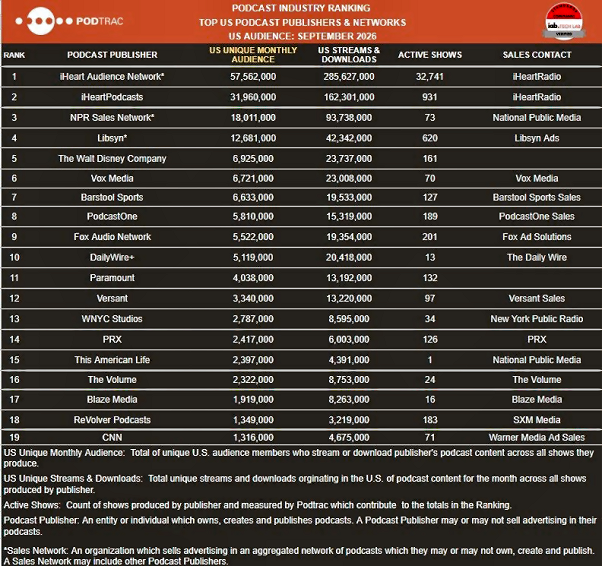
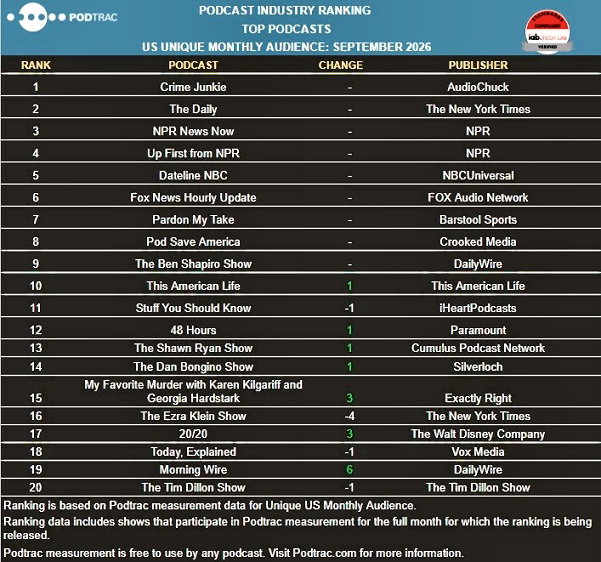
Podtrac has released its September 2026 rankings of the top U.S. and global podcast publishers and networks, along with its latest list of the 20 most popular podcasts based on unique monthly audience in the U.S. According to Podtrac, eight participants in its U.S. publisher and network rankings recorded increases in U.S. downloads compared with August, while 11 reported gains in U.S. unique monthly audience.
The iHeart Audience Network maintained its top position among U.S. podcast publishers and sales networks, reaching 57.6 million unique monthly listeners and generating 285.6 million streams and downloads across 32,741 active shows.
iHeartPodcasts ranked second with 32 million unique monthly listeners and 162.3 million streams and downloads across 991 shows. NPR Sales Network followed in third place with 18 million unique listeners and 93.7 million streams and downloads from 73 shows.
Libsyn ranked fourth with 12.7 million unique listeners, followed by The Walt Disney Company in fifth with 6.9 million. Rounding out the top 10 were Vox Media, Barstool Sports, PodcastOne, Fox Audio Network and DailyWire.
In the individual podcast rankings, Audiochuck's "Crime Junkie" retained the No. 1 position, followed by The New York Times' "The Daily" at No. 2 and NPR's "NPR News Now" at No. 3. NPR's "Up First" ranked fourth, while "Dateline NBC" completed the top five.
The remainder of the top 10 included "Fox News Hourly Update," "Pardon My Take," "Pod Save America," "The Ben Shapiro Show" and "This American Life."
Several podcasts improved their positions during September. "This American Life" climbed one spot to No. 10, while "48 Hours," "The Shawn Ryan Show" and "The Dan Bongino Show" each advanced one position to Nos. 12, 13 and 14, respectively.
"My Favorite Murder with Karen Kilgariff and Georgia Hardstark" rose three positions to No. 15, while ABC's "20/20" also gained three spots to reach No. 17.
The month's biggest upward move among the top 20 came from DailyWire's "Morning Wire," which climbed six positions to No. 19. Meanwhile, "The Ezra Klein Show" recorded the largest decline, falling four places to No. 16.
Podtrac's rankings are based on measured U.S. unique monthly audiences and include participating podcasts that were measured for the full reporting month. Publisher rankings also track U.S. streams and downloads across participating shows.
Audacy Highlights New Trends in Podcast Advertising
| RADIO ONLINE | Thursday, October 8, 2026 | 3:36pm CT |
|
 |
Podcast advertising is evolving beyond traditional host-read commercials as advertisers increasingly integrate their brands directly into programming, according to a new Audacy Insights report examining creative partnerships between podcast hosts and major brands.
The report highlights how advertisers including Peloton, Macy's, David's Bridal and BetterHelp are moving beyond conventional 60-second spots to develop branded segments, product demonstrations, social media extensions and full-episode sponsorships.
While host-read advertising remains an effective strategy, Audacy says advertisers are increasingly working with podcast creators to make brand messaging a natural part of the content rather than a separate commercial interruption.
One example involves BetterHelp's partnership with NBA star Draymond Green. The campaign began with advertising on Green's podcast before expanding into streaming radio, extending the host's relationship with the brand to audiences beyond his podcast listeners.
Audacy also highlighted a partnership between David's Bridal and Sofia Franklyn's "Sofia with an F" podcast. The advertiser became part of Franklyn's ongoing conversations about her engagement, with wedding-related content appearing on the podcast and dress selections featured on Instagram.
Peloton took a different approach with "The RECAP Show," hosted by former U.S. women's national soccer stars Tobin Heath and Christen Press. Beyond traditional advertising placements, the hosts tried Peloton yoga classes and shared their experiences with listeners, providing firsthand product commentary.
Other examples included a custom Aura Frames segment on Kaelyn Moore's "Heart Starts Pounding" podcast, designed around the show's horror and mystery themes, and a branded "Midi Pause" segment featuring Midi Health on Dr. Mary Claire Haver's "Unpaused" podcast.
Macy's pursued a full-episode sponsorship of "Aspire with Emma Grede," while 5-hour Energy incorporated on-screen product placement into Dana Carvey's "Fly on the Wall" podcast, with video clips subsequently distributed across social media.
Audacy says these approaches reflect a broader shift toward creator-led advertising, allowing podcast hosts to incorporate products and services into their established programming styles and audience relationships.
"The best integrations don't interrupt the show - they become a part of it," said Oxford Road Founder and CEO Dan Granger. "It works because it's native to the host, and so much more than a scripted read."
The report suggests that combining podcast advertising with streaming radio, video and social media can extend the reach of creator partnerships while providing advertisers with additional ways to connect with audiences.
Read the full Audacy Insights article here.
CRB Opens Lisa McKay Women in Radio Scholarship
| RADIO ONLINE | Thursday, October 8, 2026 | 3:32pm CT |
|
 |
Country Radio Broadcasters (CRB) and Country Radio Seminar (CRS) have opened applications for the Lisa McKay Women in Radio Scholarship, which supports emerging female radio programmers by providing an opportunity to attend CRS 2027 in Nashville.
The scholarship honors the legacy of Lisa McKay, a longtime radio programmer and industry leader whose career helped inspire women pursuing careers in broadcasting.
Eligible applicants must be female college seniors studying broadcast communications who are involved in radio programming, or female radio professionals with one to three years of experience serving as Program Director, Assistant Program Director or Music Director. All applicants must be first-time CRS attendees.
Three recipients will be selected and recognized during CRS 2027, scheduled for March 17-19 in Nashville. Each scholarship package includes full registration to the seminar, round-trip airfare and accommodations at the Omni Nashville Hotel.
The annual Country Radio Seminar brings together professionals from the Country radio and music industries for three days of educational sessions, panel discussions, workshops and networking opportunities. The event focuses on industry trends, programming strategies and professional development. Applications are being accepted through Thursday, October 22.
Additional information and application details are available at here.
Advertisement
|
AWMF Opens Entries for 52nd Annual Gracie Awards
| RADIO ONLINE | Thursday, October 8, 2026 | 10:53am CT |
|
 |
The Alliance for Women in Media Foundation (AWMF) has opened the call for entries for the 52nd Annual Gracie Awards, recognizing outstanding programming and individual achievement created by, for and about women across television, streaming, radio, podcasting and digital media.
The 2027 awards will honor work produced between January 1 and December 31, 2026. The early-bird submission deadline is December 10, 2026, with a final deadline of January 21, 2027.
"Each year, the Gracie Awards recognize work that does more than capture attention; it informs, entertains and ensures women's voices and perspectives are seen and heard," said AWMF President Becky Brooks. "We look forward to honoring the content that moved audiences in 2026 and continuing the Gracies' long-standing investment in the people who will shape what comes next."
Several changes have been introduced for 2027, including the establishment of a dedicated Podcast division separate from Digital Media. New podcast categories include Video Podcast - Co-Host/Ensemble and Audio Documentary/Narrative Non-Fiction. The Video Podcast category has also been expanded to distinguish between Lifestyle/Entertainment/Sports and News/Investigative/Education programming.
For radio broadcasters, a new Public Service Announcement or Community Engagement category has been added to Local Radio. Additional categories recognize digital and social short-form video and content creators.
National winners will be honored at the Gracies Gala on May 25, 2027, at the Beverly Wilshire in Beverly Hills, CA. Local and student winners will be recognized at the Gracies Luncheon on June 15, 2027, at Cipriani on 42nd Street in New York.
Returning as co-chairs are Heather Cohen, President of The Weiss Agency; Annie Howell, Chief Communications Officer at Hallmark Media; and Mike McVay, President of McVay Media Consulting.
NCTA - The Internet & Television Association, in partnership with AWMF, will also offer scholarships covering entry fees for eligible student and professional content creators.
The Gracie Awards serve as AWMF's largest annual fundraiser, supporting educational programs, scholarships and initiatives advancing women in media.
Connecticut Broadcasters Honor Radio's Best for 2026
| RADIO ONLINE | Thursday, October 8, 2026 | 11:09am CT |
|
 |
The Connecticut Broadcasters Association (CBA) honored three longtime radio professionals among its five Hall of Fame inductees and recognized the state's top radio outlets, personalities and programs during its 2026 awards ceremony Wednesday, October 7, at the Aqua Turf Club in Plantsville, CT.
The radio inductees include Mike Lapitino of WPLR (99.1) New Haven, Courtney Nadeau of WKSS (KISS 95.7) Hartford and former Nutmeg Broadcasting President Mike Rice.
Lapitino is celebrating his 40th anniversary at WPLR, where he has been a fixture in afternoon drive since joining the station in 1986. His radio career began in 1976. Beyond broadcasting, he has hosted the annual Mike Lapitino Golf Tournament for 29 years, raising hundreds of thousands of dollars for women's health care and breast cancer awareness.
Nadeau has spent more than three decades at WKSS, beginning as part of the station's morning team with Ross Brittain. She currently hosts "Courtney & KISS in the Morning," combining entertainment, pop culture and listener interaction.
Rice, a former broadcast engineer and station owner, served as President of Nutmeg Broadcasting, which owned WILI-AM and WILI-FM in Willimantic for 46 years before selling the stations to Hall Communications in 2005. He also held leadership positions with the CBA, serving as Chairman in 2000-2001 and President through 2013.
The association also inducted television broadcasters Keith Kountz of WTNH and Bob Maxon of NBC Connecticut.
In the annual CBA station awards, iHeartMedia's Country WWYZ (92.5) was named Radio Station of the Year, while Connecticut Public's WNPR received Best Non-Commercial Radio Station honors.
Other radio winners included Adam Rivers of WKSS/WKCI for Best Air Personality, Daniela Doncel of Connecticut Public/WNPR for Best News Reporter and "Anna & Raven" on WEZN-FM for Best Morning Show.
WTIC-AM earned two awards, with "Nighttime Neighbors" recognized as Best Talk Show and the station's "Holiday Stores" initiative winning Best Community Initiative or Station Promotion. WWUH at the University of Hartford received the College Radio Excellence Award.
"The CBAs and Hall of Fame Induction evening give us a wonderful opportunity to celebrate the incredible talent and dedication of Connecticut's radio and television professionals," said CBA President Jennifer Parsons. "It's a night to recognize the work we do, the people who make Connecticut broadcasting so special, and the strong sense of community that connects us all."
iHeartMedia Announces 'A Different World View' Podcast
| RADIO ONLINE | Thursday, October 8, 2026 | 11:18am CT |
|
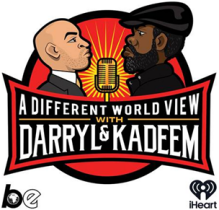 |
iHeartMedia and Charlamagne Tha God's Black Effect Podcast Network have announced "A Different World View with Darryl & Kadeem," a new weekly podcast hosted by actors Kadeem Hardison and Darryl M. Bell. The series premieres Thursday, October 15, with new episodes released weekly.
Nearly four decades after portraying Dwayne Wayne and Ron Johnson Jr. on the television sitcom "A Different World," Hardison and Bell will reunite to revisit the series episode by episode. The podcast will feature behind-the-scenes stories, reflections on the show's cultural impact and conversations with former cast members.
Each episode will also include discussions about entertainment, pop culture, sports and other topics, drawing on the hosts' nearly 40-year friendship. The pair will also explore the upcoming Netflix sequel series, featuring conversations with members of both the original and new casts.
Actress, director and producer Debbie Allen will appear as the podcast's first guest as Hardison and Bell begin their rewatch with Season 2, Episode 2, Allen's first episode with the original series. The conversation will explore her arrival on the show and its evolution under her leadership.
Allen also serves as an executive producer of the upcoming Netflix sequel, directs its premiere episode and appears as Dr. Langhorne. Hardison and Bell will reprise their original roles in the new production.
"I am beyond excited to finally launch the 'A Different World View with Darryl and Kadeem' podcast," Bell said. "Kadeem and I have only wanted to do this for over 25 years, and the time is now!"
Black Effect Podcast Network President Dollie S. Bishop said the series will introduce new audiences to the show's legacy while offering longtime fans previously untold stories.
"'A Different World' had an undeniable impact on Black culture, and Kadeem and Darryl are such an important part of that legacy," Bishop said. "We're excited to give them a platform to bring their friendship and comedy to listeners everywhere."
The podcast will be distributed by iHeartPodcasts as part of the Black Effect Podcast Network. New episodes will be available Thursdays on the iHeartRadio app and other podcast platforms, with video episodes also available on YouTube.
FOX Sports Radio Launches LaVar Arrington Podcast
| RADIO ONLINE | Thursday, October 8, 2026 | 4:33pm CT |
|
 |
FOX Sports Radio (FSR) has launched "Who We Are: Penn State," a new podcast hosted by FOX Sports Radio personality and former Penn State All-American linebacker LaVar Arrington. The series, which debuted October 8, is the first installment in a new alumni-focused podcast franchise.
Presented by the Penn State Alumni Association, the podcast is available through Arrington's Up On Game Podcast Network, distributed by iHeartPodcasts.
Produced by FOX Sports Radio and Arrington's media company DisruptU PSU, "Who We Are" will feature university-specific editions developed in partnership with alumni associations across the country.
The inaugural Penn State edition features conversations with distinguished university alumni, exploring the experiences, relationships and defining moments that shaped their personal and professional lives. Each guest's story will be presented in a two-part conversation hosted by Arrington, a College Football Hall of Famer.
"I'm really excited about this opportunity with iHeartRadio to deliver alumni-focused content, and create a platform to share and celebrate these incredible stories," said Arrington. "Penn State helped shape the person I am today, so it's especially meaningful to launch this franchise with my alma mater."
Arrington added that the goal is to expand the franchise to additional universities and alumni communities nationwide.
The series is designed to highlight the personal stories behind notable graduates while celebrating the connections and experiences that continue beyond their college years.
New episodes of "Who We Are: Penn State" will be released throughout the football season on the iHeartRadio app and other podcast platforms. Full video episodes will also be available on YouTube.
Advertisement
|
John Hakim Elevated to GM of Saga Charleston
| RADIO ONLINE | Wednesday, October 7, 2026 | 3:08pm CT |
|
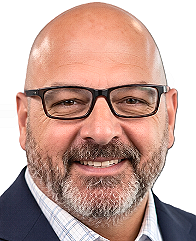 |
Saga Communications has promoted John Hakim to General Manager of its Charleston, SC, operations, succeeding Paul O'Malley. Hakim moves into the role after serving as Director of Sales for the Charleston cluster for the past five years. Before joining Saga, he held positions with Cox Media Group in Jacksonville.
O'Malley recently was elevated to Senior Vice President of Revenue Development for Saga. He will continue to support revenue initiatives across the company while assisting with the leadership transition in Charleston.
"John has earned the trust and respect of our world-class team through his leadership, integrity, and unwavering commitment to our clients and colleagues," O'Malley said. "Over the past five years, he has demonstrated the vision, work ethic, and ability to inspire others that define outstanding leaders."
Saga COO Wayne Leland said the promotion reflects the company's commitment to developing leadership from within the organization.
"He understands our culture, our communities, and the evolving needs of our clients," Leland said. "John has played a significant role in Charleston's success, and we are confident his leadership will position the operation for continued growth and innovation."
WOSF Named NCAB Metro Radio Station of the Year
| RADIO ONLINE | Wednesday, October 7, 2026 | 2:55pm CT |
|
 |
Urban One's WOSF (105.3 RNB) in Charlotte has been named Metro Radio Station of the Year by the North Carolina Association of Broadcasters (NCAB), marking the station's first NCAB honor.
The award was presented Tuesday, October 6, during the NCAB Awards Luncheon at The Pavilion at the Angus Barn in Raleigh. The recognition honors WOSF's efforts to connect with the Charlotte community through its programming and community involvement.
"We are incredibly honored to receive this recognition from NCAB," said Radio One Charlotte Vice President and General Manager Marsha Landess. "This award reflects the hard work, passion, and dedication that Jeff Anderson and our on-air and off-air team bring to the station every day."
Landess added that she was proud to see the team's commitment to listeners, the community and advertising partners recognized by the association. "Radio has changed a lot over the years, but our mission hasn't," said WOSF and WOSF-HD2 Operations Manager Jeff "Uzi D" Anderson. "We're here to serve, connect, and make a real difference in the community."
Anderson credited the station's staff and listeners for the recognition, adding, "It's an honor to have NCAB recognize the work we do both on and off the air."
YouTube Leads Podcast Platforms in Edison Study
| RADIO ONLINE | Wednesday, October 7, 2026 | 11:36am CT |
|
 |
YouTube continues to lead as the platform used most often by U.S. weekly podcast consumers, according to new Q3 2026 data from Edison Research at SSRS.
The latest Edison Podcast Metrics findings show YouTube has the highest percentage of weekly podcast consumers who identify it as the platform they use most often to listen to or watch podcasts. Edison said the growth of podcast content on YouTube has significantly changed the podcast ecosystem as the video platform continues to gain ground as a destination for podcast consumption.
Spotify ranks second, with 17% of weekly podcast consumers saying it is the platform they use most often. Apple Podcasts ranks third at 9%, remaining ahead of numerous other podcast platforms but representing a smaller share of consumers than in the past.
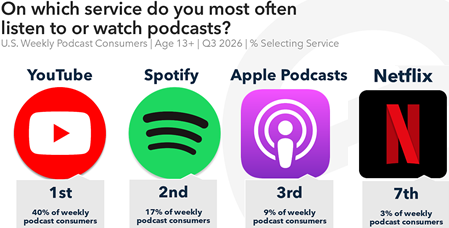
Edison also highlighted Netflix's emerging role in podcast consumption. The streaming service ranks seventh, with 3% of U.S. weekly podcast consumers saying Netflix is the platform they use most often to listen to or watch podcasts.
While that share remains relatively small, Edison noted that the figure represents only consumers who identify Netflix as their most-used podcast platform and does not reflect all podcast consumption occurring through the service.
The research firm said the latest results demonstrate the continuing shifts in how audiences access podcast content, with individual platforms gaining and losing share over time.
Edison Podcast Metrics tracks podcast listening and viewing behavior among U.S. weekly podcast consumers, with updated platform data available to subscribers each quarter.
NAB Names Hellum Radio Board First Vice Chair
| RADIO ONLINE | Tuesday, October 6, 2026 | 10:36am CT |
|
 |
The National Association of Broadcasters (NAB) has named Townsquare Media Chief Operating Officer Erik Hellum first vice chair of the executive committee for the NAB Radio Board, while Salem Media Group CEO Dave Santrella has been appointed to the Radio Board of Directors. Both appointments are effective immediately.
Hellum, a current NAB Radio Board member, oversees Townsquare Media's 336 radio stations and digital marketing services across 74 markets. He currently represents the Southern Texas District on the Radio Board and succeeds Allen Power on the executive committee.
Hellum previously served as president of GapWest Broadcasting before its acquisition by Townsquare in 2010. Earlier in his career, he held management positions with Bonneville International in St. Louis and Phoenix and worked for Katz Radio in several major markets. He later served as vice president of sales for AMFM Inc. and led early cross-platform sales efforts at Clear Channel.
Hellum recently completed a term as chairman of the Radio Advertising Bureau and now serves as the organization's immediate past chair.
Santrella, who became CEO of Salem Media Group in 2022 after 12 years as president of broadcast media, assumes the New England District Radio Board seat previously held by Power.
During his tenure at Salem, Santrella has overseen the launches of the Salem Surround digital platform, Salem Podcast Network, SalemNOW and Salem News Channel. Before joining Salem in 2001, he worked at WMAQ-TV and WBBM-AM in Chicago.
Santrella previously served as chairman of the NAB Board of Directors from 2021 to 2023. He is also a recipient of the NAB National Radio Award and was named a 2026 Giants of Broadcasting and Electronic Arts honoree.
Audacy Index Ranks Markets for NFL Fan Intensity
| RADIO ONLINE | Tuesday, October 6, 2026 | 2:25pm CT |
|
|
Buffalo tops the list of U.S. markets with the most avid NFL fans, according to new research from Audacy examining where football fandom is strongest and how highly engaged fans consume sports content.
Audacy's "NFL Attention Index" measures fandom across three areas - avidity, engagement and performance - to examine the amount of time, energy and attention fans devote to the NFL and how that engagement can translate for advertisers.
Buffalo leads the index with a score of 135, followed by New Orleans at 120 and Cincinnati at 119. Dallas-Fort Worth and Kansas City tie at 115, followed by Baltimore, Milwaukee and Harrisburg-Lancaster-Lebanon-York at 113. Philadelphia scores 111 and Columbus, OH, rounds out the top 10 at 110.
The research found that highly engaged NFL fans devote significant time to sports beyond watching games. Nearly one-quarter spend at least six hours each week following sports content, including 15% who spend six to 10 hours and 7% who spend 11 hours or more.
Audacy said audio attracts a particularly high concentration of avid sports fans, providing an outlet for discussion and analysis throughout the week when games are not being played.
The study found 47% of avid NFL fans follow news about their favorite teams at least weekly. On game days, 43% watch pre- or post-game programming on television or streaming services, 24% simultaneously follow social media and 14% use a second or multiple screens. Another 16% tailgate.
Fan engagement also continues away from games, with 41% following athletes or influencers on social media and 61% saying they enjoy having "inside knowledge." The research found 41% engage in sports betting at least monthly.
NFL fandom also plays a role in personal identity for many of those surveyed. Sixty-nine percent said being a fan makes them feel part of a community, while 61% said their love of sports is a major part of who they are.
Audacy also cited Nielsen Commspoint analysis examining the effect of radio advertising on NFL "super fans." Among those exposed to radio advertising, the analysis attributed a 56% impact on awareness, 49% on consideration, 51% on purchase and 41% on loyalty.
According to Audacy, radio advertising moved NFL super fans through each stage of the purchase funnel more effectively than advertising on television, Facebook, YouTube and connected TV.
The company said the findings illustrate that the opportunity for advertisers extends beyond reaching fans during games to connecting with highly engaged audiences consuming NFL-related content throughout the week.
Read the full Audacy Insights article here.
Advertisement
|
Advertisement
|
Advertisement
|
Advertisement
|
Advertisement
|
Advertisement
|
|
Copyright © 1989-2026 RADIO ONLINE ® |

