Home Login RADIO ONLINE RSS Facebook
Advertisement

Streaming Country Music Listeners Grew 36% Last Year


P1 Media Group
P1 Media Group

Streaming Country music grew 36% in the U.S. from 2018 to 2019 according to MRC Data/Nielsen Music. 54% of American Country Radio P1 listeners report streaming every day to a service like Pandora, Spotify or Apple Music. 85% of Country Radio P1s between the ages of 18-44 report streaming to an on-demand audio service either "every day" or "a few a day's a week."
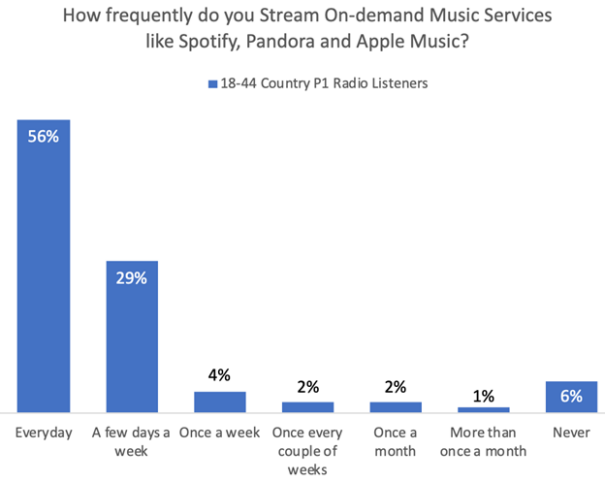
"If you are programming a Country radio station today, the streaming audience is impossible to ignore with more than half of Country radio listeners between the ages of 18-44 reporting streaming music via an on-demand music services every day" said P1 Media Group co-founder Ken Benson. "With so many Country radio listeners using on-demand streaming services, we examined the differences between what radio is playing versus listener choices using on-demand audio streaming services."

"As a proponent of using streaming data to help make programming decisions, I'm excited to see real research showing the correlation between radio listeners and on-demand streaming users," added MRC Data/Nielsen Music's Haley Jones.

Key findings:

  • Streaming to Country Music grew by 36% from 2018 to 2019.

  • Radio is playing more contemporary music than on-demand Streaming services. 70% of radio's Top 100 most-played songs are from 2018 and 2019 versus only 55% of songs from on-demand streaming services.

  • Radio relies more on Core Artists playing more songs from fewer artists while on-demand streaming services play more unique artists.

  • Radio plays less variety than the on-demand streaming services. Of the Top 500 songs on Country radio, 62% of the total spins come from the Top 100 songs versus only 46% for on-demand streaming.

  • The responses from Country Radio P1 listeners indicates that Country stations either missed or underplayed the biggest hit of 2019 "Old Town Road."

Advertisement

Latest Radio Stories

Urban One Sets 10-for-1 Reverse Stock Split
Urban One
Urban One
Urban One said its board has approved a 10-for-1 reverse stock split covering all classes of its common stock, including the publicly traded Class A and Class D shares. Stockholders had previously authorized the move on June 18, 2025, granting the board discretion on the final ratio. More

Alex Siciliano to Exit NAB Communications Role
Alex Siciliano
Alex Siciliano
National Association of Broadcasters Senior Vice President of Communications Alex Siciliano will depart the organization at the end of next week after deciding to pursue another professional opportunity. In a note shared with industry contacts, Siciliano said it had been an honor to work on behalf of More

Local Radio Drives $437B, Supports 909K U.S. Jobs
Wood & Poole Economics and BIA
A new economic study finds that free, local radio remains a powerful engine of the U.S. economy, generating $437 billion in annual GDP and supporting more than 909,000 jobs nationwide, underscoring radio's role as essential infrastructure in communities across the country. The analysis, conducted by More
Advertisement

Drive-Time Congestion Expands Radio's In-Car Reach
Katz Radio Group
Katz Radio Group
As daily traffic congestion rises across major U.S. metro areas, new insights point to an expanding opportunity for brands to reach attentive in-car audiences, with AM/FM radio continuing to dominate in-vehicle audio listening. According to a new analysis from Katz Radio, the More

Three Top 100 Markets Shift Ratings to Eastlan
Eastlan
Eastlan
Three more Top 100 radio markets are moving their audience measurement to Eastlan as the company's expansion continues into 2026. Honolulu, Reno and Tulsa will now be continuously measured by Eastlan, reflecting what the company describes as a broader reassessment by More

AEI Paper Argues FCC Has Outlived Its Purpose
Mark Jamison
Mark Jamison
A new working paper from the American Enterprise Institute contends that the Federal Communications Commission has outlived the economic and technological conditions that justified its creation and should be disbanded. Authored by economist Mark Jamison, the paper argues that the FCC was designed in 1934 More

Return to Menu

Advertisement

Subscribe to our Newsletter
Radio news and headlines delivered right to your e-mail box -- and it's free.

Advertisement

Advertisement