





Advertisement
|
Audacy & Nielsen Study Finds that Radio Gets the Votes
| RADIO ONLINE | Thursday, February 15, 2024 | 3:28pm CT |


|
 |
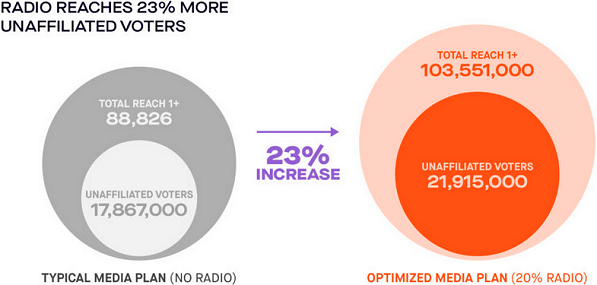
Audacy partnered with Nielsen on a new political study, which notes if a campaign reallocated 20% of existing ad dollars to Radio, it could reach 17% more voters. With many of the 2024 local, state and federal elections expected to be hotly contested, every bit of exposure will be critical. Radio may be a difference-maker in 2024 contests, helping campaigns extend reach, deliver hard-to-reach demographics, and optimize media plans.
"Incorporating radio into the broadcast mix early and often will result in better outcomes," noted Audacy Senior Vice President of Strategy , Partnerships and Analytics Jon Blum. "Radio complements TV's ability to reach undecided voters that are unreachable on TV."
As recently as 2020, campaigns relied heavily on linear TV to reach voters, but media disruption is upending old political ad tactics. As linear TV viewership declines, campaigns see diminishing returns for expensive investments.
Audacy SVP and Head of Research & Insights Idil Cakim writes, "With campaigns under pressure to find alternatives, Radio offers a cost-effective alternative with broad reach across crucial voter groups and the political spectrum. According to Nielsen's study, Radio has near universal reach (92%) across voter bases, whether Democrats, Republicans or unaffiliated voters."
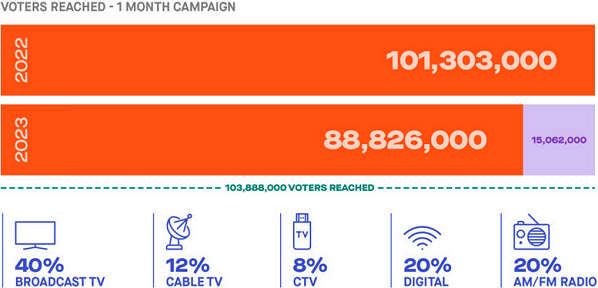
"Radio is the secret ingredient that can help a candidate win," said Haley Teare, Audacy's VP of Government and Political Partnerships. While linear TV remains important to political advertising, adding more Radio and introducing it earlier can turbocharge a campaign, extending reach and catching voters who don't watch TV (or fetch snacks and scroll social media during commercial breaks).
Beginning this spring, savvy campaign advisors and media buyers will prominently include Radio in their advertising strategy as candidates hit the campaign trail. Radio offers a broad tent to reach key voter groups, even as linear TV's audience fragments.
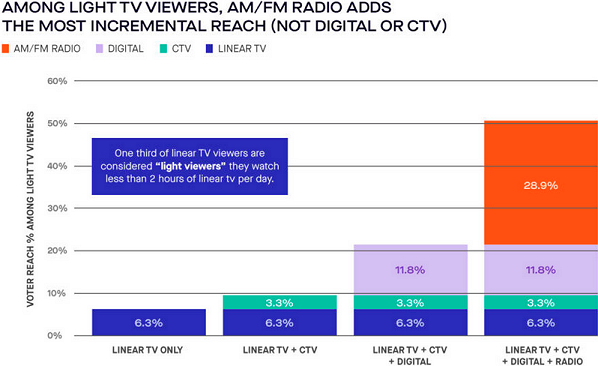
Among key voting groups, Radio offers a broader reach than linear TV and connected TV, including women, parents, Hispanic audiences, and people who don't watch TV.
"These are important constituencies you can reach easily with radio," noted Blum. On an average day, Americans are bombarded with thousands of ad messages, and that hits new highs during political season. If voters are overwhelmed or tune out, political ads miss their mark. Radio offers a more welcoming environment. According to Nielsen, about 70% of adults said TV is cluttered with too many ads, while 41% said Radio has an adequate ad load.
And Americans are more likely to avoid or skip ads on broadcast and cable TV than radio: About half of all adults surveyed said they frequently skip commercials on cable TV and broadcast TV, while only one-third reported avoiding ads on Radio. By advertising across Radio formats, campaigns can extend opportunities to engage diverse audiences. While news and talk formats are always popular, Teare said there are opportunities to follow audiences to new genres, including country, Urban, Latin, classic hits, and adult AC stations.
Radio ads also generate high attention rates, which boosts ad effectiveness. A recent study by media agency Dentsu on attention reported that 15- and 30-second radio spots commanded more attention than most other platforms, including TV.
Advertisement
|
Latest Radio Stories
Eastlan Ratings Adds Kelly and Ehrman to Support Team
|

Chris Cline Exits Reelworld as VP/AR After 18 Years
|

Fisher House Offers Free Veterans Day Radio Special
|

| Advertisement
|
Westwood One Study Challenges Eight AM/FM Radio Myths
|

SummitMedia Names Aaron Wilborn Omaha Market President
|

WUSW Launches US Country Format in Buffalo
|

Advertisement
|
Advertisement
|
Advertisement
|

