





Advertisement
|
Nielsen: AM/FM Radio Drives Vehicle Buying Decisions
| RADIO ONLINE | Tuesday, July 14, 2026 | 2:17pm CT |


|
 |
A new Nielsen study suggests removing AM/FM radio from new vehicles could have a significant impact on consumer purchasing decisions, with many buyers saying they would reject vehicles that lack the feature. The report, "Tuned In: Why Removing AM/FM Radio Is a Multi-Billion Dollar Gamble for Automakers," was conducted in partnership with iHeart in May 2026 and surveyed more than 1,000 recent and prospective vehicle buyers.
The findings conclude that traditional radio remains one of the most valued in-car entertainment options despite the growth of streaming services and connected infotainment systems.
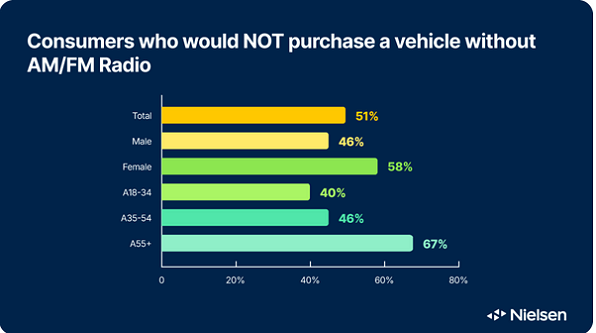
According to the study, roughly half of respondents said they would refuse to purchase a vehicle without AM/FM radio, while more than seven in 10 believe it should be included as standard equipment. Nielsen found that consumers rank AM/FM radio alongside smartphone integration such as Apple CarPlay and Android Auto, and ahead of satellite radio and built-in subscription music services.
The research also examined actual listening habits. Drawing on Edison Research's first-quarter 2026 Share of Ear data, the report found that AM/FM radio accounts for 55% of all in-car audio listening, compared with 16% for streaming audio. Podcasts, YouTube, SiriusXM, owned music and audiobooks collectively make up the remaining 29%.
To better understand buying behavior, Nielsen employed a Choice-Based Conjoint analysis, a methodology commonly used by the automotive industry to evaluate how consumers weigh vehicle features against price. The analysis found that AM/FM radio was the second most influential infotainment feature affecting purchase decisions, trailing only smartphone integration.
The study also warns of potential brand consequences for automakers that eliminate broadcast radio. About half of respondents said they would view a manufacturer less favorably if it removed AM/FM radio from its vehicle lineup. The effect was especially pronounced among consumers age 55 and older, a demographic that represents many repeat vehicle buyers.
Beyond entertainment, respondents cited practical benefits that distinguish broadcast radio from streaming services. Eight in 10 said receiving Emergency Alert System notifications is an important vehicle feature, while a similar percentage value AM/FM radio for real-time traffic and local news. Two-thirds also said they consider zero-latency broadcasts important when listening to live sports, particularly younger drivers, men and hybrid or electric vehicle owners.
The report found consumers are not choosing between broadcast radio and connected technologies. Instead, they prefer vehicles that offer both. While 40% of drivers said connecting a smartphone is their first action when entering a vehicle, one in four said tuning to AM/FM radio is the first thing they do.
The findings come as Congress continues to consider the AM Radio for Every Vehicle Act, bipartisan legislation that would require AM radio capability in new vehicles. Supporters argue broadcast radio remains a critical source of emergency information and local news, while opponents contend automakers should determine vehicle features without federal mandates.
Read the entire study here.
Advertisement
|
Latest Radio Stories
Connoisseur Names Flatley Long Island Sales Director
|

CMG Appoints Phil Becker to New Growth Role
|

Broadcasters Push Congress on AM Radio Bill
|
| Advertisement
|
MBC Launches 2026 Front Row Charity Auction
|

NRG Media Closes on Sale of Omaha Stations
|

Elvis Duran, Paul Heyman Launch Podrophenia
|

Advertisement
|
Advertisement
|
Advertisement
|

